
Embracing Chaos: What a Singapore Food Court Taught Me About Design
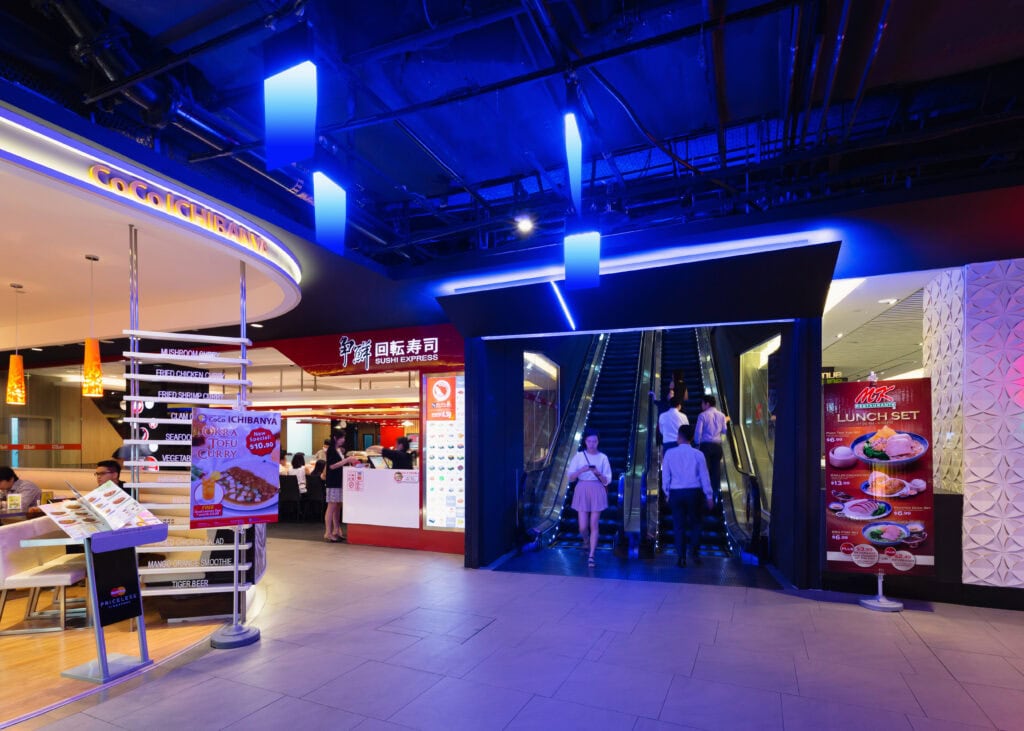
In 2014 I completed the Basement Food Court at 313@Somerset in Singapore. Ten years later, I went back. The space had changed. I hadn’t expected to feel proud of that.
I have always thought that the way we organise our space reflects the way we think. Not consciously. That is precisely why it is true.
A precise, methodical person keeps everything in place. An instinctive, emotional personality lives in a more layered, dynamic environment.
This extends beyond the individual. It shapes society.
More controlled cultures produce ordered cities. Clear grids. Aligned facades. Defined perspectives.
More adaptive cultures produce something else. Dense, layered, constantly evolving environments.
Asian cities have always fascinated me for this reason. Their apparent chaos reflects something deeper: speed, adaptability, continuous transformation. While Western culture often aims to preserve, other cultures are more comfortable with mutation.
And today, that condition is no longer local.
Uncertainty is not an exception. It is the structure of everyday life.
Markets shift. Technologies evolve. Behaviours change. Attention moves continuously. Nothing remains fixed long enough to justify absolute definition. Yet architecture still operates as if it does.
Spaces are designed for specific uses, fixed layouts, and predicted behaviours — as if the future could be anticipated and controlled.
This creates a growing mismatch. Life evolves. Space resists. And the gap between them is widening.
Uncertainty is often perceived as a problem. Something to reduce, control, or eliminate. But uncertainty is not a temporary disturbance. It is a permanent condition. And like any condition, it can be designed with.
When I designed the food court at 313@Somerset, I was working with exactly that condition.
The brief was not simple. Basement level. Below one of Orchard Road’s busiest retail destinations. High footfall, undefined identity, a space people passed through rather than chose. The challenge was not aesthetic. It was atmospheric.
The concept I built around was chaos — but intentional chaos. The density of an Asian street market, compressed into a basement. Blue light bleeding through the ceiling like a night sky. Vendors competing for attention simultaneously. Movement without resolution. The kind of energy that makes you stay longer than you planned.
The space was not designed to be calm. It was designed to be alive.
When I returned years later, some elements had been removed. The lighting increased. Several details modified over time. In a context like Singapore, where retail environments evolve rapidly, this is expected.
But something important became clear.
Despite the transformations, the spatial identity remained. The density, the layering, the informal street condition, the sense of controlled chaos — all of it was still present. The elements had changed. The atmosphere had not.
That difference matters.
You could assume I would be frustrated. That I would look at the changes and think: how could they alter my design?
But I wasn’t.
Design is not property. It is something else. Closer to life. Like children — they leave us, they evolve without us, and they must survive the world on their own.
What I saw was not a loss of control. It was proof. My design was still there. My idea had survived.
In a place like Singapore, where change is constant, surviving ten years is not a small thing. And more importantly, it evolved without me. Which means I did not create a style. I created something more durable.
A concept. Something that does not depend on form to survive.
This is where design is tested. Not at completion, but in what it becomes over time.
Uncertainty does not require less design. It requires a different kind of design. Not one that defines everything, but one that allows things to evolve. Not one that resists transformation, but one that can absorb it.
This implies a shift in authorship. The architect no longer defines a final state. The architect defines conditions. Frameworks rather than objects. Relationships rather than fixed arrangements. Capacity rather than control.
Architecture is not finished when it is delivered. It is released.
THE LESSON
Uncertainty is not a problem to solve. It is a condition to design with.
In a world where change is constant, architecture cannot rely on permanence. It must rely on resilience. Not by resisting transformation, but by surviving it.
Good architecture does not depend on remaining unchanged. It depends on remaining itself through change.
And today, that is the real challenge.
See the project: 313@Somerset — Basement Food Court