
For decades, much of retail architecture treated exposure as its highest virtue.
Show the product.
Accelerate the body.
Remove hesitation.
Convert attention into purchase.
The store became a machine for visibility. Transparent façades, illuminated interiors, open plans, escalators, mirrors, screens, signage, spectacle: everything was arranged to reduce friction between seeing and buying. The faster the customer could enter, identify, select, pay, and leave, the more successful the space appeared to be.
But that contract is breaking.
Not because retail is disappearing.
Not because people no longer want objects.
But because the transaction no longer needs architecture.
Products are already discovered online, compared algorithmically, reviewed socially, purchased instantly, and delivered automatically. The internet has absorbed the efficient part of shopping. Visibility has become cheap. Access has become continuous. Acquisition has become frictionless.
The question facing retail architecture is therefore no longer:
How can space help people buy faster?
It is:
What can physical space still do that the online cannot?
This is where the most interesting retail interiors stop behaving like stores.
They become intervals.
Spaces where consumption is delayed long enough to become atmosphere, ritual, memory, anticipation, intimacy, or cultural experience. The important retail interior today is not the one that displays products most efficiently, but the one that bridges the gap between digital desire and physical confirmation.
The store may no longer be the place where desire is satisfied.
It may become the place where desire is held in suspension.
The Object Is Already Known
This completely changes the role of architecture.
The purchase decision often begins digitally, long before the body enters the store. The object may already be familiar. It has been seen, saved, compared, reviewed, recommended, and maybe even virtually tried on. By the time the customer arrives, architecture is no longer the first point of persuasion.
It becomes the second encounter.
The object is already known.
Architecture reconstructs anticipation.
This is why the post-transaction store is not simply a showroom. It is a threshold condition: part scenography, part sensory environment, part public interior, part ritualised delay. Its role is not only to expose the product but also to thicken the moment before possession.
The customer no longer enters simply to discover.
The customer enters to verify desire physically: through atmosphere, movement, materiality, reflection, compression, and gradual revelation.
The store becomes a delay mechanism.
A pause before acquisition.
A zone of sensory adjustment.
A sequence of emotional preparation.
This is architecturally significant because delay is one of the few things physical space can still produce with force. Online retail accelerates desire toward completion. Architecture can interrupt that acceleration. It can make the body wait, approach, turn, look again, touch, hesitate, and perceive.
The showroom becomes less a vitrine than a limen.
From Display to Sequence
The important point is not that the store is stylish. It is that the retail journey is spatially sequenced. First, identity. Then engagement. Then intimacy. The object is not simply placed in front of the customer. It is approached through stages of exposure.
This is retail as controlled revelation.
The store is no longer only a place of transaction. It becomes a constructed world of waiting, learning, touching, gathering, grooming, restoring, and returning. Beauty is not only sold as a product; it is staged as duration.
This is where contemporary retail becomes architecturally revealing.
The product is no longer enough.
The brand needs a world.
The transaction needs a threshold.
The Delay Itself Becomes Architecture
Retail space no longer needs to operate through permanent exposure. In fact, the most interesting showroom may depend precisely on the delay of visibility.
Architecture slows confirmation down.
It withholds immediate completion long enough for experience to accumulate emotional weight. The disposable can temporarily become ceremonial. The ordinary can become atmospheric. Consumption can acquire duration.
This does not mean that every atmospheric store is intelligent. Most “experiential retail” is still spectacle with better lighting. The word ‘experience’ has been exhausted by repetition. Every flagship claims immersion. Every pop-up claims community. Every brand wants to become a cultural platform.
But the real question is more precise:
Does the space construct a meaningful interval between desire and possession?
That interval can slow perception, intensify awareness, produce anticipation, create memory, and transform entering, approaching, touching, waiting, and observing into part of the experience itself.
This is the deeper transformation.
The retail interior stops functioning purely as infrastructure and begins operating as mediation.
Not through speed.
Through sequence.
Not through saturation.
Through tension.
Not through infinite visibility.
Through controlled revelation.
The object becomes more powerful when approached rather than immediately consumed.
Architecture Returns Where Immediacy Fails
Digital culture collapses distance.
Architecture reconstructs tension.
This may be the reason physical retail still matters. It cannot compete with online shopping in terms of speed, inventory, or convenience. Online retail will always dominate acceleration.
Architecture operates differently.
It slows approach.
Constructs anticipation.
Frames arrival.
Charges atmosphere before release.
Cathedrals use processions.
Japanese architecture uses thresholds.
Theatres use curtains.
Stadiums use tunnels.
Hotels use revolving doors.
Sport uses the starting line.
The emotional intensity does not begin with the event itself.
It begins before release.
Retail is rediscovering this ancient spatial intelligence because the internet has made pure access instantaneous. When everything can be seen immediately, the unseen regains power. When everything can be acquired quickly, waiting becomes architectural. When the product is already known, the space around it must convey another kind of meaning.
This is not nostalgia for the old store.
It is the emergence of another retail condition: the store after visibility, after access, and after transaction.
A chamber of anticipation.
A controlled interval between impulse and action.
A place where commerce borrows from ritual.
A place where desire is delayed long enough to become meaningful again.
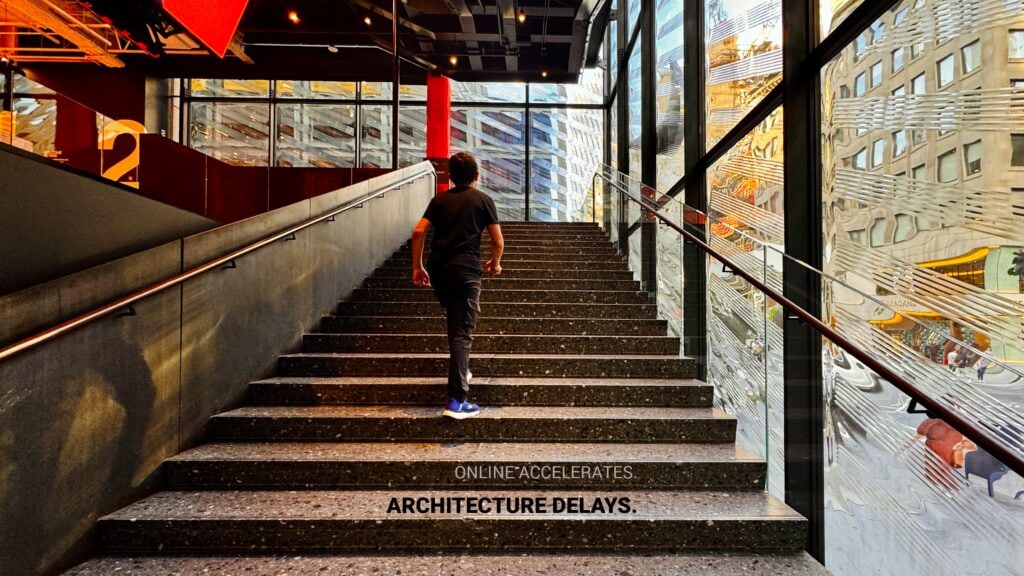
Online accelerates.
Architecture delays.
#Architecture #ArchitectureBeyondTheObject #RetailDesign #Retail #UrbanDesign #DesignCriticism