
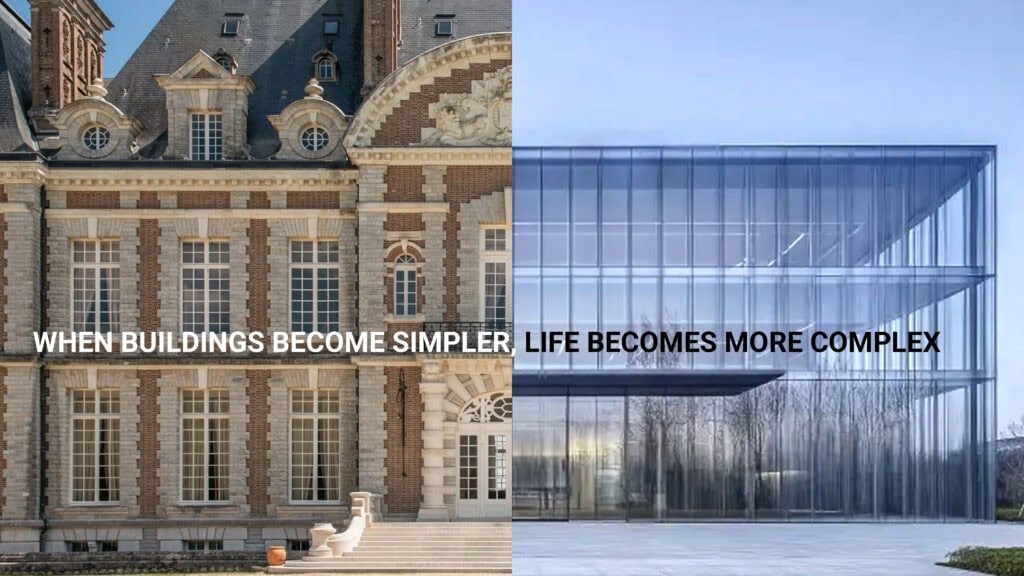
There was a time when buildings carried an extraordinary degree of complexity.
Not only through styles or historical periods, but through space itself. Interiors were layered, symbolic, dense with representation, ornament, ritual, craftsmanship, and social meaning. Architecture absorbed time, labor, hierarchy, and identity into its physical form. Buildings were heavy with intention.
At the same time, life moved more slowly.
Daily routines followed rhythms that were relatively stable and predictable. Work was physically demanding, but temporally clearer. Production, commerce, and communication unfolded within defined boundaries. Waiting was normal. Distance mattered. Most activities happened separately, one after another.
In many ways, architecture was more complex while life itself was structurally simpler.
Today, the opposite condition is emerging.
Contemporary architecture has spent years simplifying itself.
The signs are everywhere: open plans replacing subdivided rooms, neutral materials replacing ornament, flexible spaces replacing programmatic specificity, visual silence replacing spatial density. Buildings have become thinner, quieter, more generic.
At the same time, life has become extraordinarily complex.
The number of decisions a person makes in a single day has multiplied. Work no longer ends at a fixed hour. Domestic life requires managing overlapping logistical systems. Connectivity means permanent availability. Identity itself has become a project that demands constant management.
The home, once a place of relative stillness, is now expected to function simultaneously as an office, gym, warehouse, refuge, screen, and service point at the same time.
Space becomes smaller.
Time becomes interrupted.
Attention becomes fragmented.
The body is constantly asked to adapt.
This is the central contradiction of contemporary architecture:
Buildings are becoming visually simpler while life is becoming structurally more complex.
The problem is not simplicity itself. Simplicity can be profound. A simple space can hold silence, ritual, proportion, light, memory, and emotional depth. Some of the most powerful spaces in history are simple.
The problem is something else.
It is simplification without spatial intelligence. Reduction without tension. Minimalism without density. Calmness as an image rather than calmness as an experience.
Much contemporary architecture is not truly minimal.
It is merely reduced.
And this reduction often creates a dangerous illusion: space appears resolved while the life happening inside it becomes increasingly overloaded.
The kitchen shrinks while domestic logistics expand.
The home becomes visually calm while the family inside it becomes structurally overwhelmed.
The office becomes open and flexible while the worker inside it loses spatial boundaries between focus and rest.
Architecture has simplified its surfaces while life has multiplied its demands.
And the body — the actual user of space — is left to negotiate between a simplified environment and an increasingly complex existence.
This raises a serious question for contemporary practice.
If architecture is to serve life — genuinely serve it, not merely represent an ideal of it — then simplification must be earned, not assumed.
A simple space that absorbs complexity without erasing it is a sophisticated architectural achievement.
A simple space that merely ignores complexity is a failure dressed as refinement.
The question is not whether buildings should be simple or complex.
The question is whether simplification is genuinely improving life, or merely making increasingly compressed conditions appear acceptable.
If life becomes structurally more complex, should architecture continue becoming simpler?
And if this process continues, will architecture eventually be reduced to a final device?
#architecture #minimalism #design #urbandesign #contemporaryarchitecture #architecturedesign #designcriticism #builtenvironment