
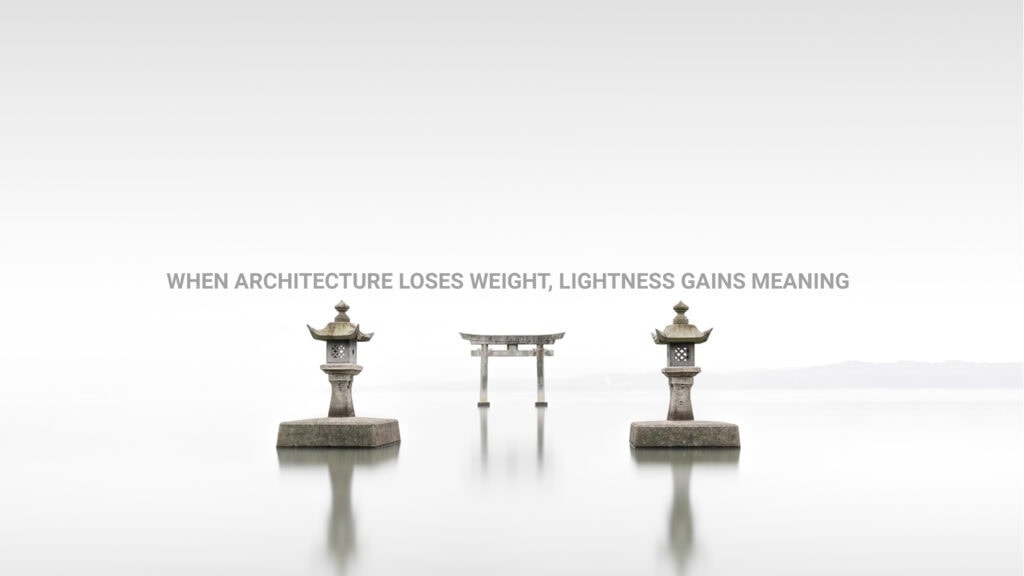
How little architecture is still architecture?
What if architecture no longer needed to begin with addition? What if the future of architecture depended not on building more, but on intervening with extreme precision?
An industrial shell remains. Systems are exposed. The room is barely transformed. A curtain, a lamp, a mirror, a chair, a plant. Almost nothing has been added. And yet something changes. Attention slows down. The body reorients itself. Atmosphere emerges. The room begins to gather meaning.
This may be one of the most important architectural questions emerging today.
For decades, architecture associated importance with visibility, complexity, formal expression, and material presence. More geometry, more systems, more façade, more image, more object. At the same time, contemporary life became increasingly saturated with excess: visual, informational, material, digital, and spatial. Against this condition, another architectural intelligence is quietly becoming more relevant. Not minimalism as style, nor emptiness as aesthetic branding, but architecture as precise intervention.
What is changing today is not simply taste. The cultural threshold of what is perceived as “complete architecture” has shifted. Spaces that twenty years ago might have been considered unfinished, temporary, raw, or economically constrained are now often understood as refined, atmospheric, intelligent, and contemporary. This transformation matters because it suggests that architecture may be entering a new phase in which meaning no longer depends on the quantity of form, matter, or construction.
And perhaps this is not entirely negative.
Less demolition, less waste, less material consumption, less embodied energy, less construction excess. Reduction can become a form of intelligent lightness. The question is not whether architecture should become lighter. The question is whether lightness can still carry meaning.
Because reduction without intelligence produces poverty. Lightness without depth produces emptiness. And a space with almost nothing that communicates nothing is not minimalist architecture. It is simply an empty room.
The minimum of architecture is not, therefore, defined by quantity. It is defined by transformation.
A curtain can become architecture if it produces atmosphere. A plant can become architecture if it anchors attention. A mirror can become architecture if it expands perception. A chair can become architecture if it organises encounter.
The minimum of architecture is, therefore, not the minimum quantity of objects. It is the minimum intervention capable of transforming perception.
This changes the architectural question entirely. The issue is no longer only how much architecture can build, but how much meaning architecture can produce with almost nothing.
This may explain why many contemporary interiors increasingly operate through a language of near-disappearance: light partitions, transparent layers, neutral palettes, temporary atmospheres, exposed systems, editable frameworks, and soft boundaries. The object becomes lighter, the structure retreats into the background, and the room becomes less a composition of objects and more a perceptual condition.
This tendency is cultural before it is architectural. Digital culture itself increasingly values lightness, transparency, adaptability, low-presence interfaces, and frictionless environments. Increasingly, designed objects are expected to withdraw. They should organise experience without interrupting it. They should guide attention without aggressively declaring themselves. Architecture seems to be absorbing the same logic.
The danger is not that architecture becomes lighter. The danger is that architecture becomes lighter without becoming more meaningful. That lightness becomes a shortcut rather than a discipline. That near-disappearance becomes an excuse rather than a strategy.
The challenge today is similar, but perhaps even more radical. Can architecture become lighter, softer, more temporary, more adaptive, and more sustainable while still preserving psychological depth? Can almost nothing still produce orientation? Can a room be transformed without being filled? Can architecture withdraw as an object while intensifying as an experience?
These questions matter because the future probably does not need more architecture as an object. It needs more meaningful architecture. Not more material for its own sake. Not more form for visibility alone. Not more complexity to prove intelligence. But more precise interventions capable of changing how we perceive, move, pause, gather, interact with the environment, and relate.
THE QUESTION:
The question is not “Will architecture disappear?”
The question is, “Will architecture be able to produce meaning even with less?”
The future of architecture may not depend on building more. It may depend on knowing exactly where to intervene. The future of architecture is not a heavier form. It is a higher meaning with lower material intensity.
And perhaps the good news is that meaning may be architecture’s lightest material.
#architecture #minimalism #design #interiordesign #atmosphericdesign #architecturedesign #lightness #builtenvironment