
There is an idea I keep coming back to:
Retail may be one of the last common grounds we have left.
Religion has lost much of its former collective solidity. Politics too. We no longer necessarily share the same ideology, the same idea of progress, beauty, family, work, or even what responsibility towards the environment should mean.
But we still shop.
Consumption somehow survived the fragmentation of almost everything else.
For decades, the shopping centre was one of the few places where almost everyone could still participate in the same ritual. Rich or poor, young or old, conservative or progressive, local or foreign: you could enter the same building, walk the same corridors, look at the same objects, eat in the same food court and participate, at very different levels, in the same system.
You did not need to agree with anyone.
You just needed to be there.
This is why I think we underestimate what retail architecture became.
The mall was never only a machine for selling things. It was also an extraordinarily successful machine for producing co-presence.
People met there. Teenagers occupied it. Families spent afternoons there. Older people walked through it. Children played in it. People watched other people. You could arrive without knowing exactly what you wanted and sometimes leave without buying anything at all.
Even today, a family of four can sit around the same table, each absorbed by a different device. Their attention may no longer be shared.
But their bodies still are.
Commerce financed the space, but human presence became one of its products.
In increasingly fragmented cities, the shopping centre became something strangely close to a civic interior. Not because it was democratic — it wasn’t. Not because it was genuinely public — usually, it wasn’t that either.
But because it was shared.
During winter it offered warmth, shelter and light. During summer, free air-conditioning. Somewhere to walk. Somewhere to sit. Somewhere to wait, sometimes without having anywhere else to go.
At times, that alone is enough reason to be there.
And now we may be dismantling the very conditions that made that space necessary.
THE TRANSACTION HAS ALREADY LEFT
The first function of retail architecture has already largely escaped the building: the transaction.
We no longer need a shop to search. We do not need one to compare prices, read reviews or pay. Increasingly, we do not even need to actively look for what we want. Algorithms recommend it. Platforms remember it. AI filters it. Delivery systems bring it to us.
Even the interface is beginning to disappear.
Biometric payment systems can identify a hand or a face. Cash disappears. The card disappears. Potentially, even the phone disappears.
The technology itself is not becoming immaterial — quite the opposite. Behind this apparent frictionlessness lies an enormous physical infrastructure of servers, data centres, warehouses, fulfilment centres, logistics networks, energy systems and delivery fleets.
But from the user’s point of view, it is becoming increasingly invisible.
The distance between desire and acquisition keeps shrinking.
The shop became the webpage.
The webpage became the feed.
The feed is becoming the agent.
Soon, the most efficient shopping experience may be the one in which we barely experience shopping at all.
But something else has happened at the same time.
Our attention left the building too.
The device in our pocket does not merely allow us to buy things. It has absorbed many of the empty moments that once belonged to physical space: waiting, looking around, getting bored, talking to whoever happens to be beside us, watching strangers, getting lost, walking without a destination.
These seem like insignificant behaviours.
They are not.
They are some of the small, uncontrolled conditions from which public life is made.
And increasingly, they are occupied by a screen.
E-commerce threatens the shop.
Digital life threatens the reason to go there.
Because if buying no longer requires physical presence, and social interaction increasingly does not require it either, what exactly remains of the architectural premise of the shopping centre?
THINGS + PEOPLE + PLACE
The mall solved a very twentieth-century equation:
THINGS + PEOPLE + PLACE.
Bring enough things into one location and people will come.
Bring enough people and more things will follow.
Add restaurants, cinemas, cafés and entertainment and they will stay longer.
Footfall becomes value.
But technology is breaking that equation apart.
Things can come to us.
People can reach us through a device.
Entertainment follows us everywhere.
And the device itself keeps moving closer to the body: from the desktop to the laptop, from the laptop to the phone, from the phone to the watch, the glasses and perhaps eventually interfaces we barely perceive as separate objects at all.
In a sense, the mall has been progressively miniaturised.
The building is what gets left behind.
And perhaps retail architecture is already revealing the pressure.
At one end, ordinary retail becomes increasingly thin: neutral shells, exposed services, raw finishes, reduced architectural theatre. Efficiency is enough.
At the other end, destination and luxury retail move in precisely the opposite direction. They become more spectacular, immersive and expensive. Architecture has to perform. It has to give us an experience strong enough to justify leaving the screen.
The middle becomes increasingly difficult to defend.
Either the building becomes almost irrelevant, or it has to work extraordinarily hard to give us a reason to enter it.
There is something strange about this inversion.
The digital environment becomes richer, more seductive, more personalised and endlessly variable, while much of ordinary physical retail becomes increasingly generic.
Perhaps the explanation is simple.
The spectacle migrated to the feed.
WHAT GETS LEFT BEHIND IS ENORMOUS
And this is where the question stops being primarily technological and becomes architectural.
Because what gets left behind is enormous.
Decades of retail development have produced a vast physical inheritance: shopping centres, department stores, retail parks, big-box buildings, parking structures and acres of infrastructure organised around one fundamental assumption — that human beings would continue travelling somewhere in order to consume.
These buildings are not insignificant remnants.
They occupy valuable land. They contain enormous quantities of embodied carbon. They have roads, utilities, transport connections, servicing infrastructure and huge floor areas. Many sit exactly where growing cities desperately need housing, education, healthcare, workplaces, public space and social infrastructure.
So perhaps the future of retail is no longer primarily a retail question.
It is a real-estate question.
And eventually, an architectural one.
What do we do with an enormous building type when the behaviour that created it no longer requires architecture?
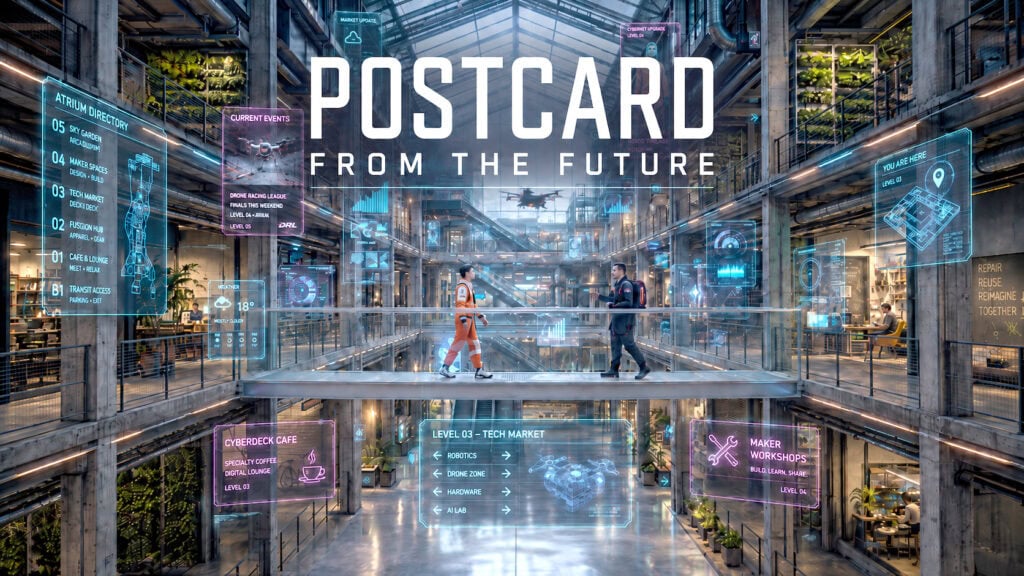
We are already beginning to see answers. Former shopping centres are becoming educational campuses, housing, workplaces, healthcare facilities and mixed-use districts. Researchers have even adopted the term demalling to describe the process through which shopping centres progressively lose their exclusively commercial function and acquire new uses.
But I am less interested in predicting which programme will replace which mall.
Housing?
Schools?
Hospitals?
Care facilities?
Sports?
Urban agriculture?
Production?
Data infrastructure?
Perhaps all of them.
The more interesting question is what principle should guide the transformation.
And perhaps the answer is surprisingly primitive:
What still requires a body to show up?
You can buy without going anywhere.
You can work without going anywhere.
You can watch a film without going anywhere.
You can speak to friends on another continent without going anywhere.
More and more of what once generated architecture can now happen through a signal.
But you still need physical space to care for someone.
To grow food.
To repair something.
To make something with your hands.
To play a sport.
To feel the acoustic pressure of a concert.
To teach a child how to use a tool.
To sit beside someone who is ill.
To experience heat, cold, weight, texture, smell, scale and distance.
To encounter another person you did not choose from a list.
Perhaps those apparently ordinary experiences will become increasingly valuable precisely because they cannot be made frictionless.
WHEN ARCHITECTURE GETS THE BUILDINGS BACK
This is where the enormous real-estate legacy of retail becomes genuinely interesting.
The shopping centre may turn out to have been an accidental reservoir of future civic space: privately built, commercially financed, strategically located structures waiting for a society that no longer needs them for their original purpose.
There is something almost ironic about that possibility.
For decades, we allowed consumption to become one of the strongest organising forces of our common physical life.
We built monumental spaces for it.
Connected highways to it.
Wrapped public transport around it.
Dedicated enormous areas of our cities to it.
And perhaps, just as consumption becomes capable of freeing itself almost completely from physical space, architecture gets the buildings back.
Not necessarily empty.
Released from their original identity.
Perhaps stripped back to structure, circulation, services, enclosure and climate. No longer required to constantly seduce us, because architecture cannot compete with the infinite stimulation of the feed anyway.
A building no longer asking us to desire anything.
Just space.
Infrastructure.
Capacity.
Available.
Maybe the future of the mall begins when we stop asking how to make people shop there again.
Maybe the real opportunity begins when we accept that they may not need to.
Because if retail really was one of our last common grounds, its disappearance leaves us with a much bigger challenge than finding another tenant.
It leaves us with the space itself.
And with a question that has almost nothing to do with shopping:
What will become our next reason to be together?
And what should we do with all the buildings waiting for an answer?