
What is Concept Design in Architecture?
Concept design in architecture is the foundational phase where a project’s core idea is defined before any technical decisions are made. It translates a client’s vision, site conditions, programme requirements, and strategic goals into a single coherent design direction — one that guides every decision that follows.
A design concept in architecture is not a style or an aesthetic preference. It is a structured idea: an organising principle that connects the why of a project to the how of its design. When it is strong, everything that comes after becomes clearer, faster, and more aligned.
Design Concept vs Concept Design: What Is the Difference?
The terms are often used interchangeably, but they describe two related things:
- A design concept is the core idea itself — the organising principle that gives a project its identity, direction, and logic.
- Concept design is the phase or service through which that idea is developed, tested, and communicated.
You cannot have one without the other. A design concept without a proper concept design phase is just a sketch on a napkin. Concept design without a strong core idea produces technically competent but ultimately forgettable architecture.
Why Concept Design Matters
Most projects fail not because of technical errors but because of unclear thinking at the beginning. When a project lacks a strong concept, every design decision becomes arbitrary. Choices about form, material, programme, and experience compete with each other rather than reinforce a shared idea.
A well-executed concept design does three things:
- Reduces uncertainty. Clients and stakeholders understand what the project is trying to achieve before significant investment is made.
- Aligns decisions. Every subsequent choice — spatial, material, experiential — can be tested against the core concept.
- Creates direction that survives change. Projects evolve. Programmes shift, budgets change, teams rotate. A strong concept acts as an anchor that keeps the project coherent despite those changes.
What Concept Design Includes
Depending on the project, concept design typically produces a combination of the following:
- Concept narrative: A written description of the project’s core idea, values, and strategic direction
- Spatial strategy: How the programme is organised, how spaces relate, how circulation and experience are structured
- Feasibility thinking: An early assessment of constraints, opportunities, site conditions, and development logic
- Reference studies: Precedents, analogies, and reference projects that illustrate the concept direction
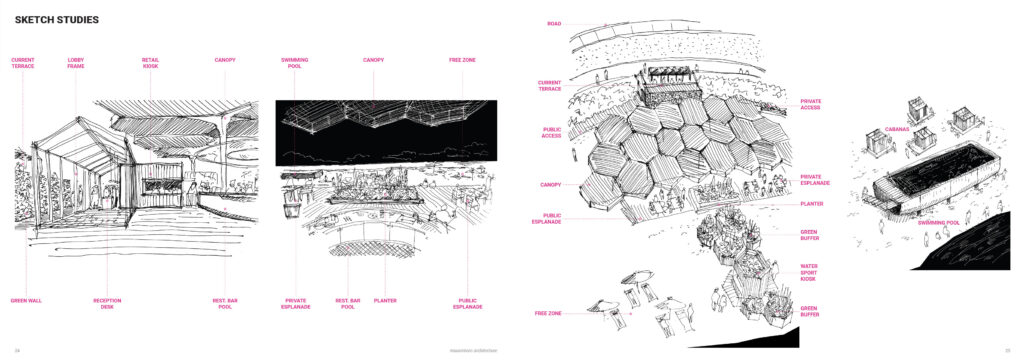
- Sketches and diagrams: Visual representations of the idea — not finished drawings, but clear thinking made visible
- Presentation material: Enough clarity to discuss, align, and move the project forward with confidence
What concept design does not include is detailed technical drawings, specifications, or construction documents. That comes later. Concept design is intentionally high-level — it defines direction without locking in decisions prematurely.
The Concept Design Process
There is no single formula, but a rigorous concept design process typically follows this sequence:
- Listen and understand. Before generating any ideas, the design team immerses itself in the client’s brief, the site, the market context, and the project’s intended users and experiences.
- Define the problem. Most clients present symptoms, not the underlying problem. The designer’s job is to reframe the brief into a clear design problem worth solving.
- Generate and test ideas. Multiple concept directions are explored, each tested against the project’s goals, constraints, and context.
- Select and develop. The strongest direction is developed into a coherent concept — articulated, visualised, and communicated clearly.
- Present and align. The concept is shared with stakeholders. The goal is not just approval but genuine understanding and alignment.
Concept Design vs Schematic Design
These two phases are often confused, but they serve different purposes:
- Concept design defines the project’s core idea, strategic direction, and spatial logic. It answers what the project should be and why.
- Schematic design translates that concept into preliminary drawings, floor plans, and technical frameworks. It begins to answer how the project will be built.
Concept design comes first and makes schematic design faster and more coherent. Without it, schematic design becomes a process of discovering problems that should have been resolved at the concept stage — which is both expensive and demoralising.
What Makes a Strong Architectural Concept?
Not all concepts are equal. In my experience, the strongest architectural concepts share several qualities:
- Clarity. The idea can be communicated in one or two sentences. If it requires a paragraph of qualification, it is not yet a concept — it is still a collection of thoughts.
- Relevance. The concept responds to something real: the site, the programme, the client’s identity, the cultural context. It is not imposed from the outside but emerges from within the project’s own logic.
- Generative power. A strong concept produces decisions. When you face a design choice, the concept tells you which option is right.
- Emotional resonance. Architecture is not just functional. The best concepts connect spatial logic to human experience — they make people feel something when they enter the space.
A concept that meets all four of these is rare. But even partially meeting them separates good architecture from merely competent construction.
Concept Design in Practice
Clients typically come to me at one of two stages. Some arrive with a clear vision — they know what they want emotionally but need help structuring it into a workable architectural direction. Others arrive with a programme and a site but no idea what the project should feel like or stand for. In both cases, the first task is the same: listen, understand, and find the idea that connects what the project needs to be with what it can become.
The biggest mistake I see is treating concept design as a preliminary hurdle to get past quickly so the “real work” can begin. It is the opposite. The concept design phase is where the most important decisions are made — not the most detailed, but the most consequential. Getting it right makes everything that follows easier, faster, and better.
Remember: no technical skill alone will lead you to the best conceptual design. A project rooted solely in technical aspects will always result in a good construction, but never in brilliant architecture.
If you’d like to see what concept architecture services look like in practice — from feasibility studies to full concept development — explore how we work at Mauro Moro Architecture.