
This piece has nothing to do with running track design at first glance. The brief for Erie Sports Center, at its core, was simple: cover the sports campus with a solar canopy. A 25-hectare site with American football, baseball, and soccer fields needed shelter and a source of energy. A canopy solves both, shade below, solar panels above. Brief delivered.
But a brief delivered is not the same as an opportunity taken.
A solar canopy, on its own, is infrastructure. It does its job quietly: it keeps the rain off, it generates electricity, and most people walking through the site would never think about it again. That would have been a perfectly acceptable answer. It also would have been a missed one.
What if the canopy wasn’t just something you stood under, what if it was also something you could stand on, run along, move through? That question is where the project actually started to get interesting, and it’s the part that wasn’t asked for.
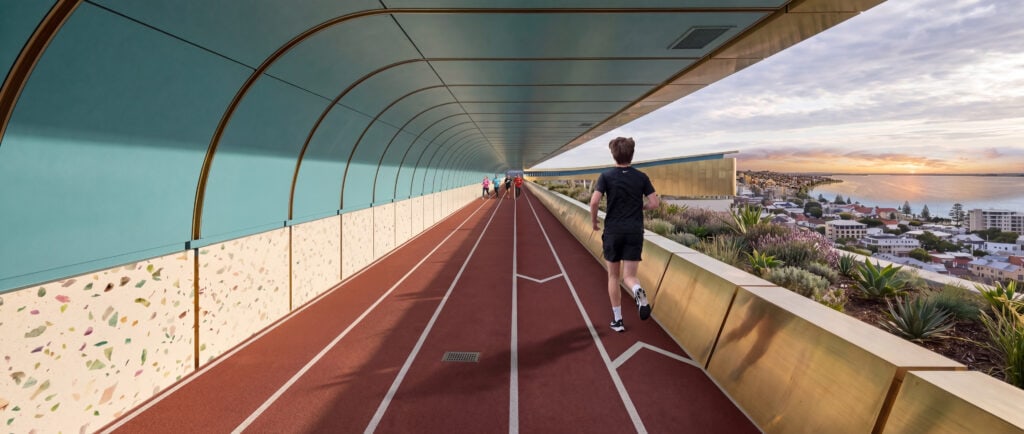
Around the canopy’s edge, we added a loop, a running track that traces the perimeter of the structure, lifted above the fields, threading along the top of the very surface that’s generating the site’s power. Suddenly the canopy isn’t just a roof with solar panels on it. It’s a piece of athletic infrastructure in its own right. Runners get an elevated, continuous circuit around the entire campus, views over the fields, a sense of the whole site laid out below them, a place to train that didn’t exist in the brief at all.
This is the spirit I care about most in this project: the canopy was the objective, but the loop and the running track are what the project actually gives. One was required. The other was offered.
I think this distinction matters more than it sounds. It’s easy to treat a brief as a ceiling, solve exactly what was asked, as efficiently as possible, and stop. But a brief is really a floor. It tells you the minimum the project needs to do to function. Everything above that floor is where design earns its place, where a roof becomes a track, where infrastructure becomes experience, where “covering the sports centre with solar panels” becomes “giving the whole campus a new way to move through and around itself.”
At Erie Sports Centre, the solar canopy still does exactly what it was asked to do, it shelters three sports fields and generates a significant share of the site’s energy. But layered on top of that requirement is a second, unrequested structure: a loop that turns the canopy into a running track, a vantage point, a piece of the campus you can actively use rather than just stand beneath.
That’s the part I’d want anyone visiting the site to notice first, not the solar panels, even though they’re doing essential work, but the fact that you can run along the top of them. The objective was a canopy. What we built was a canopy, plus a loop, plus a running track, plus a new relationship between the people using the site and the structure powering it.
Meet the brief. Then ask what else the same structure could give you for free.
In this case, that meant a complete running track design layered onto infrastructure that was never intended to be walked on, proof that the most generous part of a project can be the part nobody asked for.
Read more about the project: Erie Sports Center, Solar Canopy Sports Architecture