
Why the future of retail depends on architecture that acts as both media and community
Online retail has perfected the disappearance of space.
A product appears, a desire is registered, a payment is made, and a package arrives. The entire ritual of shopping is compressed into a sequence of private gestures: scrolling, comparing, saving, clicking, tracking. Nothing needs to be touched. No one needs to be met. No city needs to be crossed. No atmosphere needs to be entered.
Online retail does not simply make shopping faster. It removes the interval between wanting and acquiring.
That interval is where architecture begins.
The future of retail will not be won by trying to beat the internet at convenience. The internet has already won that argument. What the store can still offer is something the screen cannot fully produce: presence, encounter, hesitation, advice, ritual, and belonging.
The store after the screen is no longer a place where products wait for buyers. It becomes a sequence of thresholds where people can gain more than buying.
The question is no longer whether physical retail survives. Recent data suggests that it does. E-commerce continues to grow rapidly, yet physical stores remain central to contemporary commerce. The issue is not survival. The issue is transformation.
A store can remain open and still become architecturally dead.
The real question is what kind of space retail becomes once the transaction itself no longer needs architecture.
As AI increasingly takes over search, comparison, recommendation, replenishment, and even purchasing decisions, the role of the physical store changes fundamentally. The customer often arrives already informed, already persuaded, already connected to a digital ecosystem.
The store can no longer rely on necessity. It has to earn meaning.
This is where architecture becomes strategic.
The shop of the future must operate in two directions at once.
Outwardly, it must become media: visible, legible, memorable, capable of projecting identity into the city and into the image economy.
Inwardly, it must become community: a place where bodies gather, where knowledge is exchanged, where personal desire is temporarily absorbed into a larger collective atmosphere.
Media brings people to the threshold.
Community gives them a reason to remain.
Nike House of Innovation on Fifth Avenue (NYC) is one of the clearest examples of this condition.
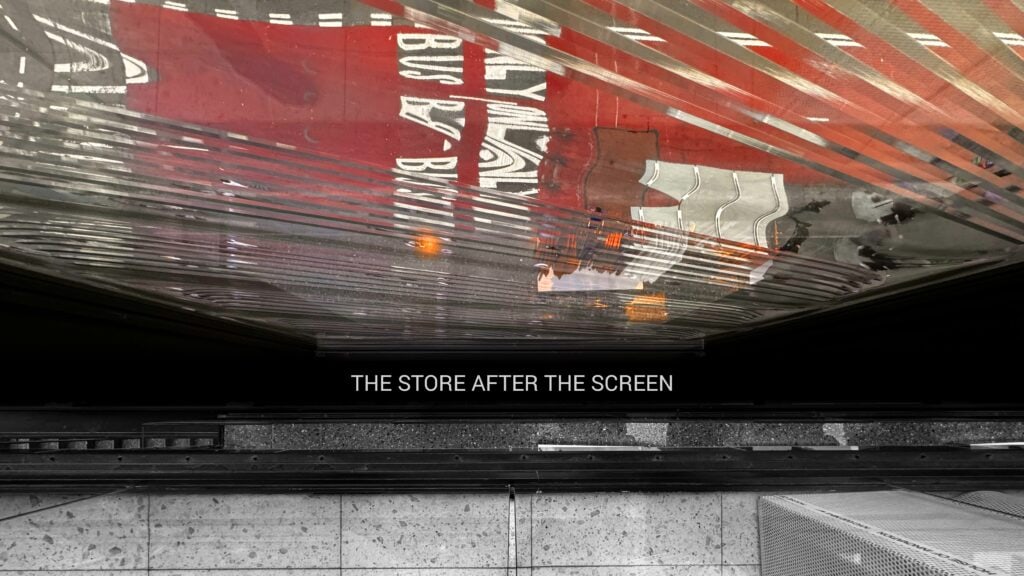
I was so impressed the first time I visited it back in 2023. Especially the glass façade. Fully glazed, yet not transparent. Translucent. And inclined as per the Nike “Swoosh”.
The building already performs before one enters it. Its six-story glass façade acts as a dynamic urban signal rather than a neutral envelope. Inside, the large vertical atrium gathers sound, video, circulation, merchandise, and spectacle into one continuous spatial event. The store does not simply display products. It stages attention.
But what makes the project relevant is not only visibility.
The store functions as a hybrid system where online and offline conditions overlap continuously: customization services, membership integration, pickup systems, flexible displays, personalized recommendations, expert guidance, and changing layouts all transform retail into an evolving spatial platform rather than a static sales floor.
The customer arrives carrying a digital trail, a product history, a membership identity, and a body that still needs to touch, test, compare, hesitate, and confirm.
This is the key shift.
The store is no longer only a machine of transaction. It becomes a space of verification.
The product may already have been discovered online, compared online, reviewed online, and even purchased online before entering the store. But architecture still offers something the screen cannot fully resolve: scale, atmosphere, material presence, fit, temperature, trust, service, and social awareness.
The store becomes important not because it shows what the screen cannot show, but because it confirms what the screen cannot guarantee.
Yet this also reveals the limitation of much contemporary “experience retail.”
Personalization is not the same as belonging.
A customer can be recognized by a system and still remain alone. A store can be full of people and still feel socially empty. Spectacle, screens, immersion, and media surfaces may intensify stimulation without producing genuine human relations.
This is the danger.
If the future store becomes only a physical version of the digital feed, architecture will have surrendered too quickly. It will have made itself visible without becoming meaningful.
The future of retail, therefore, cannot depend only on display, immersion, or technological spectacle. It must depend on relational space. It must create forms of connection that technology alone cannot reproduce.
The important question is no longer:
How do we sell?
But:
What can people do here together that they cannot do alone online?
This changes architecture completely.
The strongest stores will not necessarily be those with the most spectacular interiors, but those capable of designing meaningful transitions:
from street to atmosphere,
from curiosity to participation,
from product to body,
from individual to group,
from transaction to memory.
This is where threshold becomes essential again.
The threshold between street and store is about invitation.
The threshold between product and person is about contact: touch, fit, testing, advice, repair, customization, hesitation.
The threshold between individual and group is about belonging: workshops, launches, running clubs, learning sessions, repair events, local collaborations, conversations, and temporary communities.
The threshold between brand and city is about responsibility. A store should not simply impose a global identity onto a local condition. It should absorb local rhythms, habits, climates, references, and forms of collective life. It must make you feel part of it.
Otherwise, “community” becomes only another word for a loyalty program.
The future of retail architecture is therefore not the store as warehouse, showroom, or content machine.
It is the store as a constructed interval. It must construct layers, ambiguity, multiplicity, and the possibility of the unknown.
Online retail removes the gap. Architecture must bring it back.
Not as inefficiency, but as meaning.
The internet is excellent at collapsing distance. It brings products closer. But closeness is not the same as connection. A screen can recommend, personalize, remember, and predict. But it cannot fully reproduce the ambiguity of being among others, in a place, at a particular moment, with the possibility of encounter.
That ambiguity is not a weakness.
It is architecture’s advantage.
Retail has long treated space as support for merchandise. The future demands the reverse: merchandise must support space.
The product becomes the reason to enter, but not the only reason to stay.
The store becomes a social condenser of micro-rituals:
trying, asking, watching, waiting, learning, customizing, meeting.
These gestures may appear small, but they are precisely what online retail removes. The most advanced retail architecture will therefore not be the most digital. It will be the most relational.
The future belongs to stores capable of being visible without becoming shallow, technological without becoming cold, and communal without becoming sentimental.
A shop should no longer be understood as a point of sale.
It should be understood as a liminal structure: a place between the solitude of desire and the possibility of shared identity.
After the screen, the store must become the gap we did not know we were losing.
At MMA, architecture is approached before form becomes fixed.
Our work focuses on the early spatial definition of projects: helping developers, brands, and institutions clarify the experiential identity, spatial logic, and emotional direction of a place before design becomes an object.
Because the most important architectural decisions are often made before architecture becomes visible.
#Architecture #RetailDesign #FutureOfRetail #PhysicalRetail #DesignCriticism #UrbanDesign