
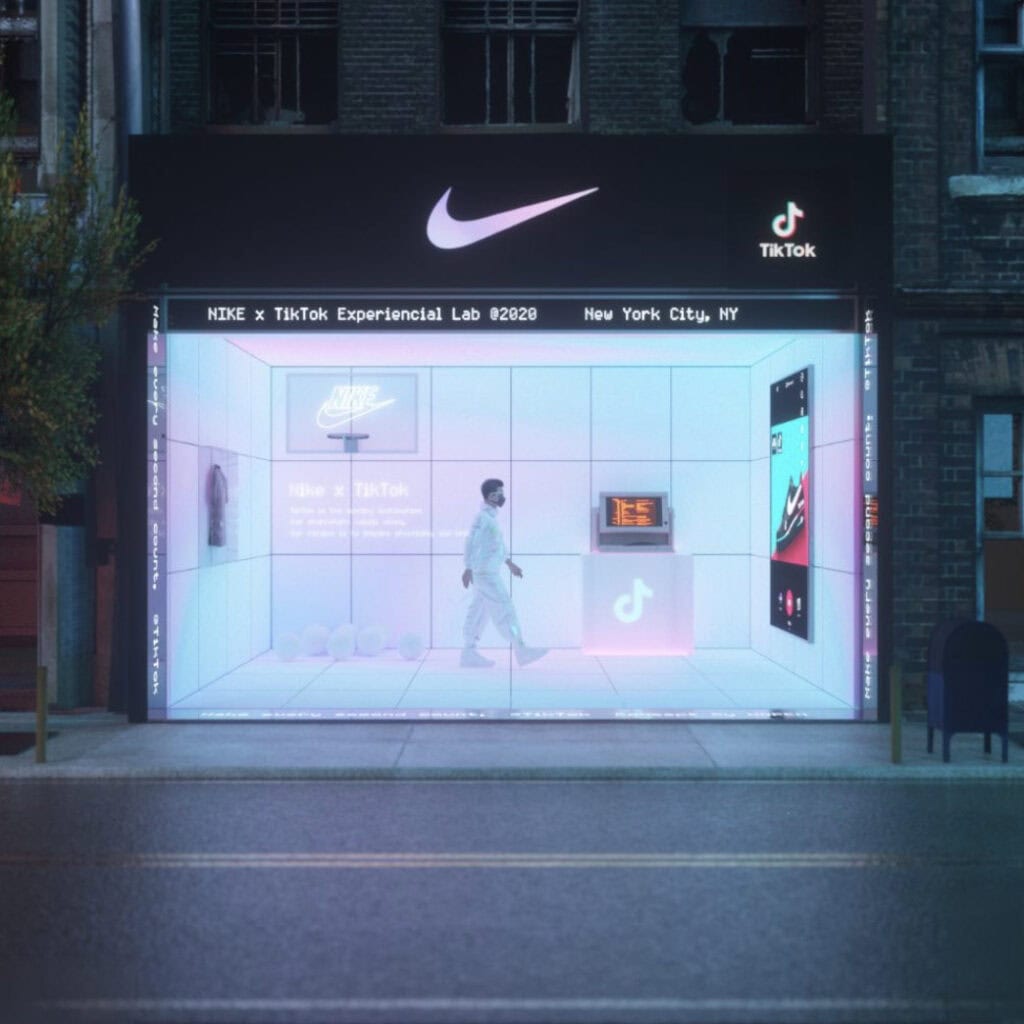
What is the threshold of a shop today? For most of retail history, it was a door, a bell, or a person behind a counter who looked up. Now it might be a click — checkout-free retail compressed into an instant. It might be a delivery worker’s knock, mediated by an app that has already told you his name, his rating, and his estimated arrival time to the minute. The threshold hasn’t disappeared, but it has been relocated from the architecture to the interface.
Marc Augé gave us the vocabulary for this shift three decades ago, and it’s worth remembering that he didn’t need retail’s current automation to make his case: the supermarket was already one of his founding examples of a non-lieu. In Non-Places: Introduction to an Anthropology of Supermodernity (1992), Augé distinguished the anthropological place, encrusted with history, relations, and identity, from the non-place, a space of pure transit where people exist as anonymous, interchangeable units. Motorways, airport lounges, hotel chains, supermarkets: what unites them is that nothing organic happens there. The turnstile, in his account, already prevents social exchange before a single word is spoken. Solitude, he wrote, is what non-places produce, even, especially, when they’re crowded.
None of this should be treated as news, and it’s worth saying so plainly: Augé wrote Non-Places before online shopping existed at all, and “the cashier is disappearing” has been a trend piece since well before this decade. The point of returning to the diagnosis now isn’t to announce it. It’s that the diagnosis has already won. Self-scan, checkout-free retail, app-only purchases: these aren’t pilots or edge cases anymore. They’re the default design brief. Which means the interesting question has quietly moved on from “what is this doing to retail” to something blunter: if the click has become the rule rather than the exception, what’s actually left for a physical shop to do?
What’s changed isn’t the category. It’s the intensity. If the mid-century supermarket was a non-place because it replaced the shopkeeper’s recognition with a price tag and a queue, the self-checkout machine removes the queue’s last human witness, the cashier, who at least had to look at you to scan your items. The delivery locker goes further still: it removes the moment of handoff altogether, replacing it with a code and a beep. The automated shopping list, Amazon Dash, smart carts that tally your basket as you walk, and replenishment algorithms that reorder detergent before you’ve noticed it’s low remove even the deliberation. You no longer enter a place to choose something. You are simply resupplied.
This is where George Ritzer’s McDonaldization thesis sharpens the picture. Ritzer, extending Weber’s account of rationalization, argued that modern institutions optimize for four things: efficiency, calculability, predictability, and control. The last of these is the one that matters most here, control achieved specifically by replacing human employees with non-human technology, because humans are unpredictable and technology isn’t. Retail automation is Ritzer’s control dimension executed almost too literally: every point of friction that used to involve a person exercising judgment. Can I help you find something? Do you have a bag? Would you like a receipt? Is exactly the point being engineered out. The industry doesn’t talk about eliminating interaction. It talks about eliminating “friction.” Same operation, cleaner word.
It’s worth noting that this logic has outlasted its own most famous experiment. Amazon has spent the last two years closing the Amazon Go and Amazon Fresh stores where “Just Walk Out” technology was born, while simultaneously expanding that same technology as a licensed product for stadiums, hospitals, and third-party retailers: over 300 locations and counting. The physical shop-of-the-future turned out to be less durable than the checkout-free logic underlying it. That’s a telling sequence: the place failed; the non-place-making mechanism didn’t. It just moved on to concession stands and campus stores, further removed from any pretense of being somewhere.
None of this is speculative, either, and it isn’t confined to whichever retailer is running the flashiest checkout-free retail pilot this quarter. Continente, Portugal’s largest supermarket chain, runs an app called Siga: you scan each item yourself as you shop, pay inside the app, and walk out through a dedicated lane where nobody checks anything. It isn’t a beta. It’s simply how a large share of Continente’s weekly shopping already happens, for anyone enrolled in the loyalty program. And it isn’t confined to commodity retail, as the phrase implies, either. Apple, arguably the most theatrically “experiential” retailer in the world, quietly removed the cashier from its own stores years ago. Buy a cable, a case, and a charger, scan it yourself with the Apple Store app, and walk out; order a phone in advance, and a specialist hands it to you minutes later, with no register anywhere in sight. Apple didn’t remove the human being from the store. It removed the human being from the transaction and kept them for everything the transaction isn’t advice, setup, and the moment of being shown something. Which suggests the real dividing line was never commodity versus luxury. It’s payment versus everything around it. The point of sale is disappearing at every price point at once. What survives is only ever what happens on either side of it.
Which brings us to your architectural point, and it’s the sharpest part of this whole line of thinking. Rem Koolhaas got there from the design side, working through OMA’s Harvard “Project on the City” seminars, which spent years treating shopping as the dominant organizing force of contemporary urban life. His conclusion, distilled into the essay “Junkspace,” was that a space designed around throughput rather than meaning develops its own aesthetic, not ugly exactly, but weightless, provisional, and incapable of accumulating the kind of significance Augé reserved for “place.” Junkspace, he wrote, is what remains after modernization has run its course: the product of an encounter between escalator and air conditioning, endlessly extendable, impossible to remember precisely because it was never designed to be memorable. It was designed to move you through.
That’s the mechanism behind the feeling you’re describing. When a retail space is optimized for automated purchase rather than for dwelling, its architecture no longer needs the vocabulary of hospitality, sightlines that invite you to linger, materials that reward touch, and thresholds that mark an arrival. It adopts the vocabulary of infrastructure instead: signage rather than ornamentation, flow logic rather than rooms, and chokepoints rather than gathering spaces. Compare the ceiling-mounted sensor grid of a checkout-free store to the atrium of an old department store built to deliberately make you feel like you’d arrived somewhere. One is engineered for cameras. The other was engineered for people who might want to stay a while. The self-checkout kiosk is Junkspace’s logical endpoint: a piece of architecture whose entire design brief is “don’t make anyone linger here.”
It would be too neat to end on pure decline, though, because the same period that produced the checkout-free grocery aisle also produced the luxury flagship-as-theatre, the hospitality-coded concept store, the return of the human concierge as a status marker rather than a service default. But Apple’s own example already complicates the tidiest version of that story, the one where commodity retail loses its humanity while luxury retail hoards it. Apple sells at a premium and still cuts the cashier. What it kept wasn’t determined by price at all; it was determined by function. Advice survives. Discovery survives. Being shown something by someone who can read your actual problem survives. Payment doesn’t, no matter what the item costs. Retail isn’t sorting its remaining humanity by price point. It’s sorting it by whether a human being was ever doing anything there besides handling money.
There’s a way to sharpen this further that goes beyond humans versus machines, though: the click is still a threshold; it’s just one where duration has been driven to zero. Marx’s term for this, buried in the Grundrisse, was the “annihilation of space by time”: capital’s habit of erasing distance not by moving through it faster but by shrinking the time cost of crossing it toward nothing. David Harvey renamed this “time-space compression” to describe how postwar capitalism kept resolving its own crises of overaccumulation by accelerating turnover everywhere, including the interval between wanting something and having it. Paul Virilio pushed the same logic into something closer to ontology: for him, speed doesn’t just cross space faster; it dissolves the interval itself. Instantaneity and ubiquity, he argued, don’t shrink distance so much as eliminate the need for a “there” to travel to at all. Manuel Castells gave the retail version its cleanest formula, distinguishing the “space of places”, which is staffed, clocked, and bound to duration, from the “space of flows”, which runs on what he called “timeless time”, instantaneous, sequence-blind, and indifferent to waiting. A door has a bell because it has a built-in duration: you stand there while it opens. A click has nothing to wait through, because the space on the other side of it has already been made timeless. Which means the design question was never really space versus non-space. It’s whether you’re designing for a threshold that still has time inside it or one that has had its time compressed to zero, and once you frame it that way, the click stops looking like a threshold in retreat. It looks like the most fully engineered threshold retail has ever produced, operating on a timescale too fast for the word “threshold” to still feel like it applies.
Which leaves the original question with a sharper edge. If the threshold used to mark the boundary between the anonymous street and a place where someone knew your face, and now it’s a click or a stranger’s knock at your door, then what we’ve built isn’t the absence of a threshold: it’s a threshold that has been engineered to require nothing of anyone on either side of it. Augé thought non-places produced solitude even in a crowd. The version we’ve built since then manages the more remarkable trick of producing solitude even when nobody else is in the room.
So, now what? If the payment threshold has been driven to zero duration everywhere (supermarkets, phone shops, corner stores, warehouses, etc.), checkout-free retail can no longer justify a physical location by pointing to the transaction. That argument is already lost, permanently, to whichever channel gets to zero fastest, and Siga and the cashier-less Apple Store are proof that this isn’t a fight still being fought; it’s one that’s already been decided. What’s left is only the part the click was never built to do: showing someone something they didn’t know to look for; reading a problem well enough to solve it instead of just ringing it up; and the plain fact of being in a room with other bodies, which no interface can simulate, instantaneous or not, because presence isn’t a feature; it’s the one thing that only means something if it costs you time. Retail’s job description just got narrower but also clearer. It was never really in the business of selling objects; that part is solved, ambient, and running quietly in the background of a hundred apps. What it can still do is give someone a reason to spend duration on purpose in a world that has quietly made spending none of it by default.
Related on this blog: Retail Beyond the Surface, The Store After the Screen, and Online Accelerates. Architecture Delays.
Sources consulted: Marc Augé, Non-Places: Introduction to an Anthropology of Supermodernity; George Ritzer’s McDonaldization thesis (overview); Rem Koolhaas / OMA, “Junkspace” and the Harvard Design School Guide to Shopping; reporting on Amazon’s Just Walk Out pivot (GeekWire, About Amazon); David Harvey’s time-space compression, rooted in Marx’s “annihilation of space by time” (overview); Paul Virilio’s dromology and The Aesthetics of Disappearance (overview); Manuel Castells on the “space of flows” and “timeless time” (overview); Continente’s Siga app (Continente); Apple Store self-checkout and pickup (How-To Geek).